
Session 4: Shipment Preparation - Added Services -Labeling, Documentation, and Staging
This chapter focuses on the critical final steps before a package leaves the warehouse: packing, documentation, and staging. Proper execution in this phase ensures product safety, cost-efficiency, and
Competency 7: Packing and Value-Added Services 📦
This section covers the science and strategy behind packing operations, from selecting the right materials to calculating shipping costs based on volume.
Objectives
Upon completing this section, you will be able to:
Explain the primary goals of packaging in a logistics environment.
Identify and select appropriate packing materials for various product types.
Calculate dimensional weight and understand its impact on shipping costs.
Define Value-Added Services (VAS) and provide examples relevant to a packing station.
The Goal of Packing
Packing is more than just putting items in a box. It serves two primary, equally important functions:
Protection: The main goal is to ensure the product arrives at the customer's location in perfect condition. This involves protecting it from damage due to dropping, vibration, compression, and environmental factors like moisture.
Efficiency: The second goal is to minimize cost and waste. This is achieved by using the smallest possible box (space optimization) and lightweight materials, which directly impacts shipping costs.
Packing Materials
The choice of materials is critical to achieving the goals of protection and efficiency.
Primary Containers (Boxes): The most common is the corrugated fiberboard box. They come in various sizes and strengths (burst strength rating). Choosing the right-sized box is the first step in minimizing costs.
Void Fill: This material fills empty space inside the box to prevent items from shifting.
Air pillows: Lightweight and good for filling large gaps.
Packing peanuts: Effective for irregularly shaped items.
Kraft paper: A recyclable option, good for wrapping and cushioning.
Foam inserts: Offer the highest level of protection for fragile or high-value electronics.
Sealing (Tape): High-quality, pressure-sensitive plastic tape is essential to ensure the box remains securely closed during transit.
Cushioning: Materials like bubble wrap are used to wrap individual items for shock absorption.

Mathematical Model: Calculating Dimensional Weight
Carriers charge for the space a package occupies on their vehicles, not just its actual weight. This concept is called Dimensional (DIM) Weight or volumetric weight. The billable weight is the greater of the actual weight and the DIM weight.
Theoretical Concept
A large, lightweight box containing pillows takes up much more space than a small, heavy box of books. DIM weight allows carriers to charge fairly for that space.
Algebraic Formula
The formula to calculate DIM weight is:
DIMWeight=DIMDivisorLength×Width×Height
The DIM Divisor is a number set by the carrier. Common divisors are:
139 for domestic shipments in the U.S. (when measuring in inches for pounds).
5000 for international shipments (when measuring in centimeters for kilograms).
Example: Imagine a box with these characteristics:
Dimensions: 40 cm (L) x 30 cm (W) x 20 cm (H)
Actual Weight: 3 kg
Carrier's DIM Divisor: 5000
Calculate the volume: 40×30×20=24,000cm3
Calculate the DIM Weight: 500024,000=4.8kg
Determine the Billable Weight: Compare the Actual Weight (3 kg) to the DIM Weight (4.8 kg). The billable weight is the greater value: 4.8 kg. The company will be charged for shipping 4.8 kg, not 3 kg.
Minimizing Shipping Costs
Based on the DIM weight model, here are key strategies to reduce costs at the packing station:
Use the Right-Sized Box: Always use the smallest box possible that can safely hold the product and necessary cushioning.
Consolidate Orders: Whenever possible, ship multiple items for a single customer in one larger box rather than multiple smaller ones.
Use Lightweight Void Fill: Materials like air pillows add almost no weight to the package.
Know Carrier Rules: Be aware of the specific DIM divisors and pricing tiers for each carrier you use.
Value-Added Services (VAS)
These are tasks performed at the packing station that go beyond standard packing to meet specific customer or marketing requirements.
Kitting: Assembling multiple separate SKUs into a single new unit to be sold together (e.g., a "starter kit" with several components).
Custom Labeling: Applying special labels, such as price tags, compliance labels, or branding stickers.
Gift Wrapping: Providing gift wrapping and personalized message services for e-commerce orders.
Marketing Inserts: Adding flyers, coupons, or promotional materials into outgoing packages.
comemnts
Proper packing is a balance between product protection and cost efficiency.
Dimensional weight is a critical factor in shipping costs; a smaller box is almost always a cheaper box.
Value-Added Services (VAS) can be performed at the packing station to enhance the customer experience and meet marketing goals.
Competency 8: Labeling, Documentation, and Staging 🏷️
Labeling is an essential part of the logistics process, serving as a communication tool between different stages of the supply chain. It provides vital information about a product such as its contents, origin, destination, handling instructions, and more
Once a package is sealed, it must be correctly labeled, documented, and sorted for carrier pickup. Errors in this stage can lead to lost packages, delivery delays, and customer dissatisfaction.
Objectives
Upon completing this section, you will be able to:
Identify all the essential components of a standard shipping label.
Differentiate between 1D and 2D barcode technologies.
Describe the purpose of key shipping documents like the packing slip and bill of lading.
Explain the function of a staging area and its organizational logic.
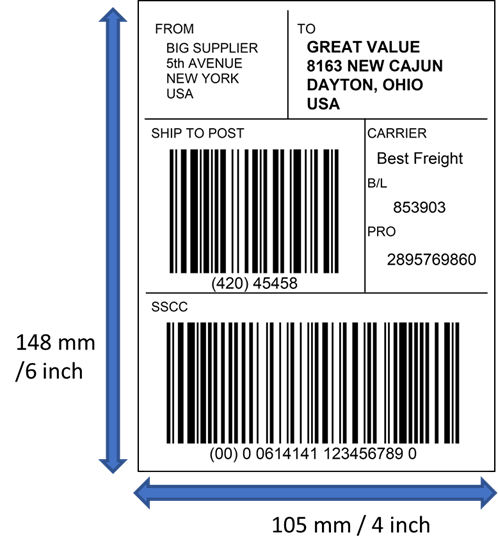
Anatomy of a Shipping Label
The shipping label is the package's passport. It contains all the information the carrier needs to transport it from origin to destination.
Key components include:
Origin & Destination: The "From" (shipper) and "To" (consignee) addresses.
Tracking Number: A unique identifier assigned by the carrier to track the package's journey.
Barcode: A scannable version of the tracking number and other data. This is the most important element for automated sorting.
Service Level: Indicates the shipping method (e.g., Ground, Express, Overnight).
Weight & Dimensions: The package's billable weight and size.
MaxiCode (UPS): A specialized 2D barcode that is easily scannable on a fast-moving conveyor belt.

Improved: Anatomy of a Modern Shipping Label
The shipping label is arguably the most critical document in the entire dispatch process. It functions as the package's brain, containing all the data required for automated sorting machines and logistics personnel to guide it accurately from origin to destination. A well-designed label is organized into logical zones for rapid machine and human readability.
Let's dissect the label zone by zone to understand the function of each component.
Zone A: Shipper Information (The Origin)
This section clearly identifies who is sending the package.
From: Company Name / Sender Name
Address: Street Address, City, State/Province, Postal Code, Country
Purpose: This address is essential for processing returns. If the package is undeliverable for any reason, it will be sent back to this address. It is also used for carrier billing and communication.
Zone B: Consignee Information (The Destination)
This is the core directive for the carrier, indicating the final delivery point.
To: Recipient Name / Company Name
Address: Street Address, Apartment/Suite #, City, State/Province, Postal Code, Country
Purpose: Accuracy here is paramount. The postal code and street address are the primary data points used by automated sorting systems to route the package. A single error in this zone is the most common cause of delivery delays.
Zone C: Service and Carrier Information
This area defines the "contract" for delivery speed and identifies the responsible carrier.
Carrier Logo: The branding of the carrier (e.g., FedEx, UPS, DHL).
Service Level: Specifies the product purchased (e.g., PRIORITY OVERNIGHT, GROUND, EXPRESS SAVER). This tells handlers how to prioritize the package at every step.
Ship Date & Bill To: Indicates when the package entered the carrier's network and who is responsible for payment (e.g., Shipper, Recipient, Third Party).
Zone D: Package Details
This section provides the physical characteristics of the package, which are crucial for billing and aircraft/vehicle load planning.
Actual Weight: The weight of the package as measured on a scale.
Dimensions: The Length, Width, and Height of the package.
Billable Weight: The greater of the actual weight or the Dimensional (DIM) Weight. This is the weight the shipper is charged for.
Zone E: The "Digital Fingerprint" - Barcodes and Routing
This is the most complex and technologically significant part of the label, enabling automation.
Tracking Number
A human-readable series of numbers (and sometimes letters).
The primary number used by customers and support agents to look up a shipment's status.
Primary Barcode
Often a GS1-128 barcode. This linear barcode encodes the Serial Shipping Container Code (SSCC) or the carrier's internal tracking number. It serves as the package's unique "license plate".
This is the main barcode scanned at every transit point. Its data provides a complete history of the package's movement.
Routing Code
A large, bolded prefix of the destination postal code or an internal hub code.
Allows both automated sorters and human handlers to quickly sort the package into the correct container or vehicle without needing to read the full address. It's designed for high-speed identification.
Specialized 2D Code
A matrix barcode like the UPS MaxiCode or a QR Code.
This code contains redundant data, often including the full destination address. Its design allows it to be read accurately even if it's partially damaged or moving at high speeds on a conveyor belt.
Exportar a Hojas de cálculo
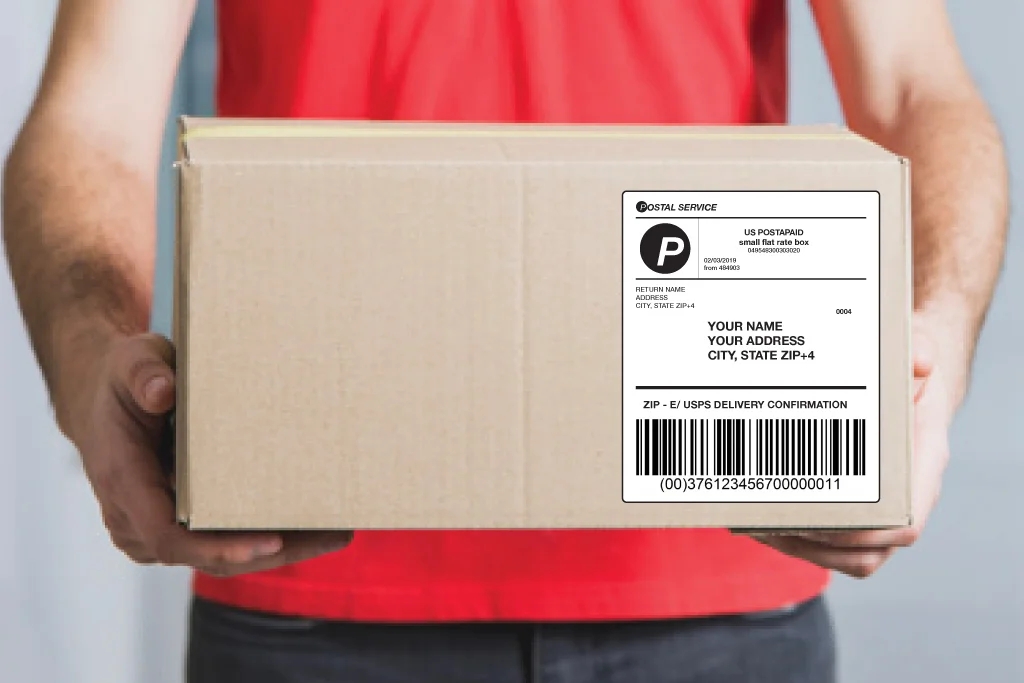
Best Practices for Shipping Labels
Creating a perfect label is pointless if it isn't applied correctly. Adhering to these industry-standard practices prevents scanning errors and delays.
✅ Use a Thermal Printer: Inkjet printer ink can smear when wet, rendering barcodes unscannable. Thermal printers burn the image onto the label, making it far more durable.
✅ Place on a Single, Flat Surface: The label should be applied to the largest, flattest side of the box.
❌ Avoid Seams and Edges: Never fold a label over an edge or place it over the box's seam. This can make the barcode impossible for scanners to read.
❌ Do Not Cover with Tape: While it may seem like protection, some tapes can create a glare that interferes with scanner performance. The adhesive on quality labels is sufficient.
✅ One Box, One Unique Label: Every package in a shipment must have its own unique label and tracking number. Never photocopy a label and apply it to multiple boxes.
Barcode Technology (1D vs. 2D)
Barcodes are fundamental to modern logistics, enabling speed and accuracy.
1D (Linear) Barcodes:
Appearance: A series of parallel lines of varying widths (e.g., UPC, Code 128).
Data Capacity: Holds a small amount of alphanumeric data, typically an identification number. The scanner looks up this number in a database to retrieve more information.
Use Case: Ideal for tracking numbers on shipping labels and identifying products (UPC).
2D (Matrix) Barcodes:
Appearance: Patterns of squares, dots, or hexagons (e.g., QR Code, PDF417).
Data Capacity: Can hold significantly more information directly within the code itself (e.g., a full address, website URL, or item details).
Use Case: Often used for more complex applications, such as on packing slips to encode the entire contents of an order or in marketing (QR codes).
Essential Shipping Documents
In addition to the shipping label on the box, other documents are crucial.
Packing Slip:
Purpose: An itemized list of the products contained inside the package. It confirms to the customer what they should have received.
Placement: Placed inside the box. It typically does not include pricing information.
Bill of Lading (BOL):
Purpose: A legally binding document that serves as a contract between the shipper and the carrier. It details the type, quantity, and destination of the goods being shipped.
Use: Required for freight shipments (LTL and FTL), not typically for small parcel shipments. It acts as a receipt when the carrier picks up the goods.
Commercial Invoice:
Purpose: A document required for all international shipments. It provides customs authorities with information about the shipment, including its contents, value, and origin, to assess duties and taxes.
The Staging Area
The staging area is a designated space in the warehouse where outbound packages are placed after labeling to await carrier pickup. It is a critical link between internal warehouse operations and external transportation. Its primary function is to organize and consolidate shipments.
Staging Logic (By Carrier, Route)
A chaotic staging area leads to shipping errors and carrier delays. Packages must be sorted according to a clear, defined logic. Common methods include:
Sort by Carrier: All packages for FedEx are placed in one lane, all for DHL in another, and so on. This is the most common method.
Sort by Service Level: Within a carrier's lane, packages may be further sorted by service level (e.g., a separate pallet for all "Overnight" packages to ensure they are loaded first).
Sort by Route: For local delivery fleets, packages are sorted into lanes corresponding to specific delivery routes or geographic zones. This allows drivers to load their vehicles efficiently.
teacher's comments
The shipping label is the single most important piece of information on a package.
Barcodes (1D and 2D) enable the automated and accurate tracking of millions of shipments daily.
Key documents like the packing slip and bill of lading serve as a record and contract for the shipment.
An organized staging area, sorted by a clear logic (like by carrier), is essential for an efficient and error-free handover to transportation partners.
Última actualización
¿Te fue útil?